
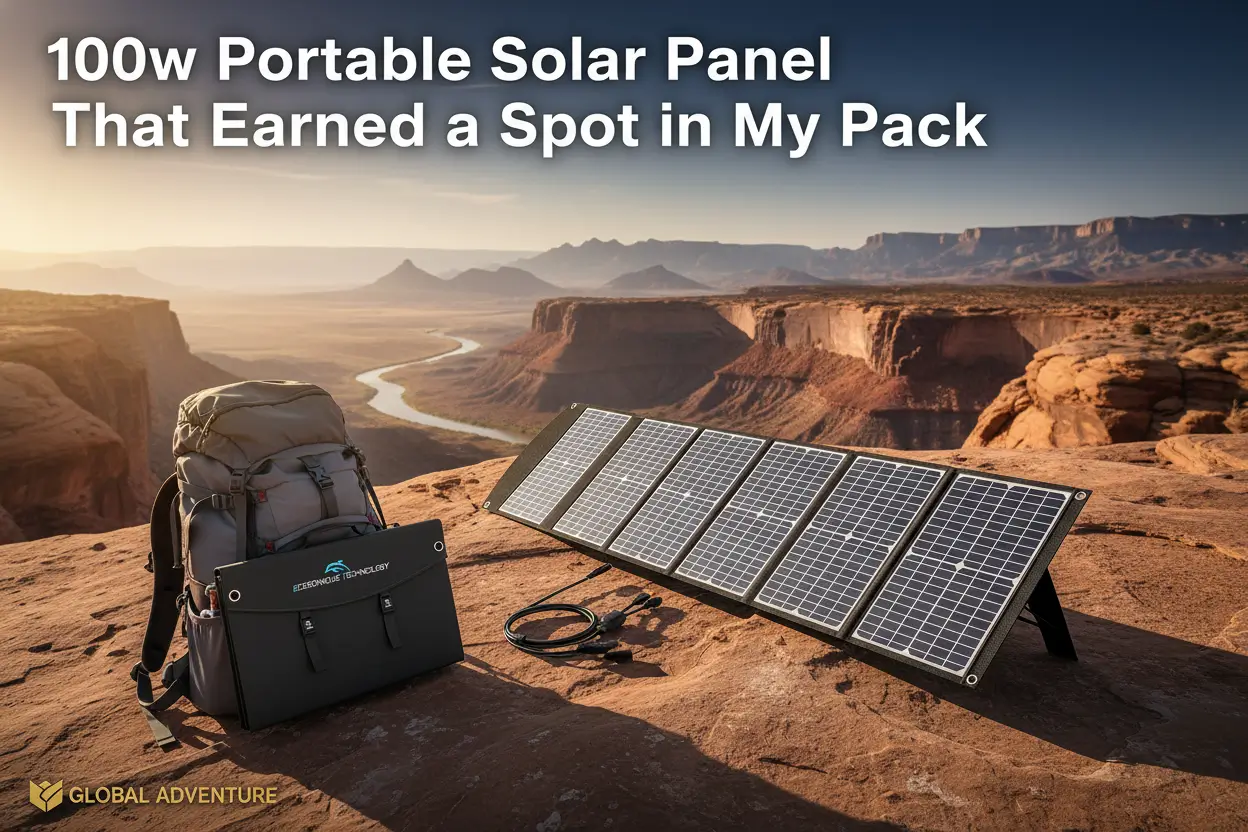

I didn’t plan to test a 100w portable solar panel on my first week-long off-grid trip, but a busted generator and a long stretch of cloudy weather changed that fast. I remember watching my power station drop to single digits and thinking, if this doesn’t work, I’m back to paper maps and dead phones for three days.
That little hair-raising moment is why I now carry this foldable 100-watt panel everywhere I plan to sleep under the sky. It folds down to laptop size, weighs about 6 lbs, and has grommets so I can hang it on a tent, RV awning, or even rig it to a backpack for a slow-charge while hiking — neat, right?
Would you rather be the person scrambling for outlets at a campsite, or the one casually topping up a power station while you brew coffee?

Why This Earned a Spot in My Bag
For me, travel gear has to pass three brutal real-world tests: packability, reliability, and usefulness. This solar panel passed all three. Here’s when I actually reach for it:
- Multi-day camping or festivals where plug access is spotty — I used it to keep a 300Wh power station topped to 60-80% on sunny days.
- RV trips where roof panels are too slow to orient — I hang this from an awning to charge batteries while I move around camp.
- Backpacking-to-basecamp days when I want emergency juice for phones and GPS — the foldable design fits in my daypack or under a sleeping bag for safe storage.
- Boat days or fishing trips — grommets make it easy to lash to rails; it’s lightweight enough that the boat balance doesn’t suffer.
If you travel light in backpacks, sleep in hostels, carry a carry-on suitcase, or stash gear in hostel lockers, this panel’s compact folded size (15.7 x 10.5 inches) and 6-fold layout matter. It fits under the seat, in overhead bins, and in a suitcase without bulk.
The Details That Matter On the Road
I test gear by breaking it a little and using it hard. These are the specs and travel-centered benefits that sold me on this panel:
- Weight & packability – At roughly 6 lbs and folding to laptop dimensions, it’s easy to sling into a backpack or slip into a suitcase. No extra checked baggage drama.
- Output & compatibility – A 100-watt panel is a sweet spot for topping a power station and charging devices. This panel includes USB QC3.0 and Type-C PD3.0 ports for phones and laptops, plus Anderson and XT60 DC outputs for generators and power stations.
- Mounting options – Integrated grommets make it simple to hang on tents, RV awnings, or nail it to a tree branch for better sun angle.
- Durability & material – The fabric fold case protects the cells during travel and the aluminum-mount points and reinforced corners stand up to being shoved in backpacks and thrown into car trunks.
- Charging convenience – Quick-charge USB means I can top a phone from 20% to usable levels fast, while the DC outputs help me keep power stations healthy on longer trips.

Mistakes I See Travelers Make With Solar Panels
I’ve watched friends buy panels and then never use them properly. Here are the usual pitfalls, from my trips and fixes I recommend.
- Picking the wrong wattage – Too small and you’ll never keep a power station topped. Too big and you add unnecessary weight. For most campers and van lifers, 100W is the practical sweet spot.
- Not thinking about connectors – You need matching ports. This panel’s USB QC3.0 and Type-C PD3.0 handle phones and laptops, and the Anderson/XT60 DC outputs handle most solar generators, but double-check your power station’s input before you commit.
- Poor sun angle – Lay it flat and expect slow charging. I angle mine toward mid-morning or late-afternoon sun using grommets and a trekking pole to gain 20-40% efficiency in marginal light.
- Storing wet gear – I always dry the panel before folding it. Damp storage can degrade materials and invite mildew, which is avoidable with quick maintenance.
- Carrying without protection – Even though the case is tough, I still slip this panel between soft clothes in my suitcase to avoid pressure points or scratches during flights.

How I Actually Use It Day to Day
When I’m on the road I keep routines tight. These are the practical steps I use to squeeze the most out of the panel without fuss.
- Unpack smart – I remove the panel from its case, check connections, and position it near where I plan to hang it. I use the grommets and a small carabiner to clip it to tent poles or awnings.
- Match the cables – I carry a short suite of cables: a Type-C PD cable, a USB-C to USB-C, and the Anderson/XT60 leads for my power station. I verify polarity before connecting to avoid any mistakes.
- Angle for sun – I tilt the panel with a trekking pole or prop it on a cooler to face the sun. Even a 15-degree change can improve output when clouds roll by.
- Monitor and move – I check the power station every couple of hours. If clouds block the sun, I re-orient the panel or pack it away to avoid moisture exposure.
- Pack dry and flat – Before folding, I wipe the cells and let the panel air for five minutes. Then I fold it and slip it into a padded sleeve or between clothes in my bag.
If You’re Hesitating, Read This
I had doubts the first time I bought a foldable panel. Here are the hesitations I heard from myself and other travelers, and how they played out in the field.
- Is it bulky? – For me it’s not. The folded 15.7 x 10.5 inch size means it fits where a laptop does. If you absolutely must travel with minimal grams, you might choose lighter single-pane panels, but you lose the 100W power.
- Will it survive travel? – I treated it roughly: shoved in suitcases, tied to backpacks, and it held up. The reinforced grommets and protective case help. I still avoid sharp creases and store it against soft items.
- Do I really need both USB and DC outputs? – Yes. I use USB for phones and PD for a laptop, while DC outputs go straight to my power station. It saved me from carrying extra adapters.
- What about maintenance? – Light care: wipe, dry, and avoid saltwater spray. That’s it. No complex upkeep required.

I pack this panel because it solves a clear travel problem: reliable, modular charging without heavy rooftop installs or noisy generators. It makes sense for campers, RVers, van lifers, and anyone who wants backup power for phones, cameras, and small power stations while keeping luggage space and weight manageable.
Some links are affiliate. As an Amazon Associate, I earn from qualifying purchases – at no extra cost to you. It helps keep these finds coming. Thanks for your support!