
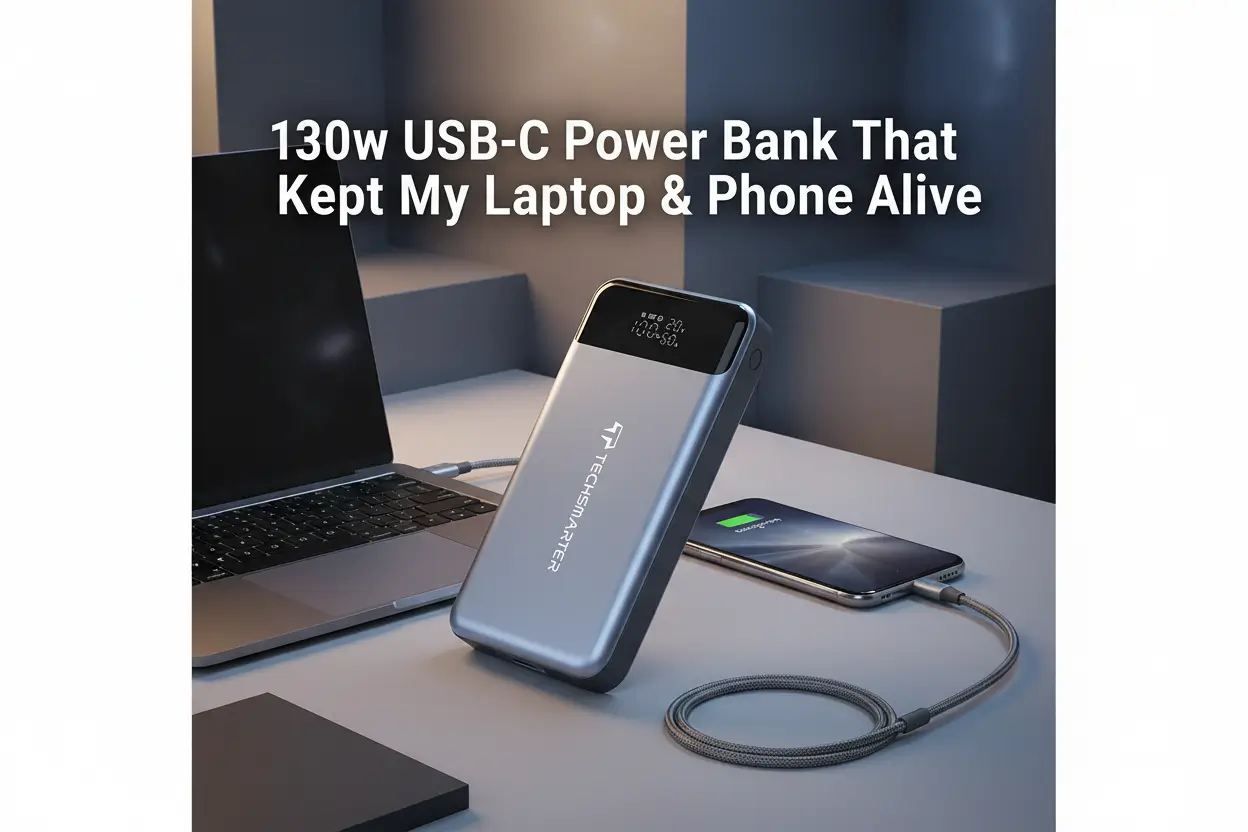

I landed in Lisbon for a 7-day trip with a dead laptop battery and a single wall outlet in a hostel common room. My backup plan was a 130w usb-c power bank I’d packed on a whim. It saved my deadline and let me keep working in a café for hours longer than I expected.
On paper it sounds boring: a big battery and some ports. In practice it kept my MacBook Pro, iPhone, and a friend’s Steam Deck topped up during a 12-hour travel day with 3 layovers. It’s 30,000mAh capacity with three fast outputs and pass-through charging that actually works.
So if you hate hunting for outlet real estate while juggling a suitcase and a coffee, would a single charger that handles laptops and phones simplify your life?

Why This Earned a Spot in My Bag
If you travel like I do – lots of flights, random co-working cafes, and occasional hostel life – you want one piece of gear that covers everything. For me this 130w usb-c power bank is that piece. Real scenarios where it helped:
- Long haul flight + layovers: I charged my laptop at 100W while my phone topped up from the 22.5W USB-A port during boarding and between flights.
- Workdays in cafés: I ran a MacBook Air and an iPad Pro for a half-day without swapping sockets.
- Road trips and trains: It kept a Chromebook and a friend’s Galaxy S23 going when the car inverter wasn’t cutting it.
- Gaming on the go: The Steam Deck held its battery longer when I used the 30W USB-C PD port for mid-session boosts.
It’s not for someone who never leaves home; it’s for people who need reliable charging in carry-on friendly form and don’t want to babysit cables and outlets.
The Details That Matter On the Road
I’m picky about materials, weight, and interface. This charger sold me because its design choices matched what I actually do when traveling.
- Ports that work: Three outputs – a 22.5W USB-A port, a 30W USB-C PD port, and the headline 100W USB-C PD port. That 100W output is what lets me charge my laptop at near-full speed.
- Pass-through charging: I can charge the power bank and devices at the same time while plugged into a wall. That overnight trick gives me a full bank and full devices by morning.
- Battery capacity: 30,000mAh means multiple phone charges and at least one full laptop top-up depending on the model.
- Build and portability: Feels dense but solid – not fragile like cheap plastic bricks. It fits in an outer pocket of a daypack or inside my suitcase carry-on without taking over.
- Compatibility: Worked with my MacBook Air/Pro, iPhone 16, Pixel, Galaxy S24, iPad Pro, Chromebook, and even a Steam Deck during testing.

How I’d Choose Between Similar Options
When I compare chargers, these are the trade-offs I think through. They helped me pick this 130w usb-c power bank over smaller, lighter options.
- Wattage vs weight: If you need laptop-level charging, a 100W USB-C port matters. That adds bulk, so expect more weight for the capability.
- Capacity vs portability: 30,000mAh gives multiple full phone charges and a laptop top-up. If you want ultralight, consider 20,000mAh instead.
- Number of ports: I prefer multiple fast outputs so I can charge a laptop and phone simultaneously without daisy-chaining adapters.
- Pass-through charging: This is non-negotiable for overnight airport runs. Some cheaper power banks can’t handle pass-through safely or efficiently.

How I Actually Use It Day to Day
- Top-up before travel: I charge the bank to full overnight the day before a trip. Pass-through charging means I can charge my phone and the bank together while packing.
- Carry-on rules: I keep it in my carry-on outer pocket for easy access at security and in-flight. Most airports allow high-capacity banks in carry-on but check airline rules if unsure.
- Laptop on the go: When I’m working in a café, I plug the laptop into the 100W USB-C port and the phone into the 22.5W USB-A. That setup extends my session by hours.
- Mid-trip boosts: On trains I use the 30W USB-C PD port for tablets and smaller laptops for faster trickle charging without the bulk of a full adapter.
- Maintenance: I avoid extreme heat, keep it in a padded pocket, and cycle a full charge every few months to preserve battery life.

If You’re Hesitating, Read This
I had several objections before I started using this. Here’s how they actually played out on the road.
- Too heavy? Yes it’s heavier than a pocket power bank. For me, the trade-off of one device that charges everything beats hauling multiple chargers in a checked bag.
- Will airlines allow it? I keep it in carry-on. Most airlines permit high-capacity batteries in carry-on; it’s not something you should put in checked luggage.
- Does pass-through damage the battery? I worried too. In my experience overnight pass-through charging worked fine and didn’t cause noticeable heat issues when left on a flat, ventilated surface.
- Compatibility with MacBook/Windows/Steam Deck? The 100W USB-C PD port handled my MacBook Air and a friend’s Dell laptop; the 30W port was perfect for tablets and smaller devices. Always use the correct cable and avoid cheap USB-C leads.
- Do I really need 30,000mAh? If you’re on day trips and some café work, maybe not. But for multi-day travel, digital nomads, or anyone hauling a laptop and phone, the capacity ends those constant outlet hunts.
I pack this 130w usb-c power bank when I want one solid charger that handles phones, tablets, and a laptop without hunting for outlets. It’s ideal for remote workers, road trippers, and anyone who values fewer cables and more uninterrupted battery life.
Some links are affiliate. As an Amazon Associate, I earn from qualifying purchases – at no extra cost to you. It helps keep these finds coming. Thanks for your support!